Ghita Nørby on gardening:
Being Completely Absorbed in Something is the Best Thing in the World
Ghita loves her roses, but emphasises that children should never be forced to work in the garden – that would only kill their curiosity. She herself inherited both green fingers and a love of gardening from her father, while her mother preferred beautiful bouquets as decorative objects. For Ghita, time spent in the garden is pure selfishness in the most delightful sense – something that fills her with energy and joy for life.
By Sannie Terese Burén, featured in Magasinet Psykologi 04/2011
Ghita Nørby hardly needs an introduction in Denmark. Whether we remember her best from films such as Dance with Regitze, from her beautifully understated role as Ingeborg Skjern in the beloved Danish television series Matador, from her many roles on the stage of the Royal Danish Theatre, or from her readings of Hans Christian Andersen’s fairy tales, she has long since found her way into people’s hearts and become something close to a national treasure in Denmark.
Perhaps she is, in fact, Denmark’s only true diva.
But Ghita is not the type to place herself on a pedestal. Quite the opposite. She keeps both feet – and preferably her hands as well – firmly in the soil, and she is happiest when she can wander about in her garden, talk a little to her flowers, notice that something needs doing, and simply get on with it.
She has written the book Ghita’s Roses – Smile at Your Ground Elder, a source of inspiration for garden enthusiasts and perhaps also for those who dream of becoming one.
Finds it Hard to Cut Her Roses
Ghita speaks to her roses every day and prefers to know them all by name. And she has to pull herself together before pruning them, even though she knows it is good for them – she almost cannot bear to do it.
Every rose has its own beauty. Whether it is an old historical variety or a modern hybrid matters less.
“I choose my roses by their charm. I simply fall for them,” she says with her characteristic laughter.
And once she has fallen for one, she will certainly find room for it in the garden – which, besides more than fifty different varieties of roses, also contains many other beloved plants: birch and beech, honeysuckle and blackberries, a late-flowering magnolia – and ground elder.
As she writes in the book:
“Ground elder is simply there – it belongs there. It is sweet, it always gives us something to do. And it is beautiful and tastes good in a salad and can even be tied into bouquets. I love my garden and I love my roses. I happily feed the birds and let the ground elder grow. With the same attitude I walk upon the earth.”
Raised on the “Drop Technique”
Life has not always been easy for Ghita, even if it may have appeared comfortable on the surface.
Her mother, who was a pianist and an aesthete, was the kind of person who, as Ghita describes it, would “walk into a ditch, pick flowers and arrange beautiful bouquets. Then she would sit beside them and read lofty books or play Chopin on the piano.”
“The problem with such a ‘happy family’,” Ghita says, “is that you are rarely just a happy child. We contain so many different things, and if you are only loved when you are a certain way, it becomes difficult to be yourself.”
“You are not supposed to say that you do not love your mother… But honestly, I never did.”
In her book Ghita describes how she was brought up with what she calls a kind of drop technique. Her mother would give her a tiny drop of love to survive on — and then another just when she was about to give up.
“Then I would become so happy,” she says. “Because then everything was good again for a while, until the next drop came. But never enough to truly flourish.”
She was allowed to decide nothing for herself and grew up to be a deeply dependent person.
“That is why I have spent a wonderful fortune learning how to become a human being,” she says with a smile. “And I am deeply grateful that psychologists exist — otherwise I would hardly be anyone at all.”
Her mother lived to the age of ninety-eight, and over the years Ghita learned to handle their relationship.
“But I admit that it never really became good,” she says.
She owns a bust of her mother made by the sculptor Ludvig Brandstrup.
“Sometimes I take it out into the garden during the summer and place a rose on her head. It is a gesture from my side — but a rose she will never become.”
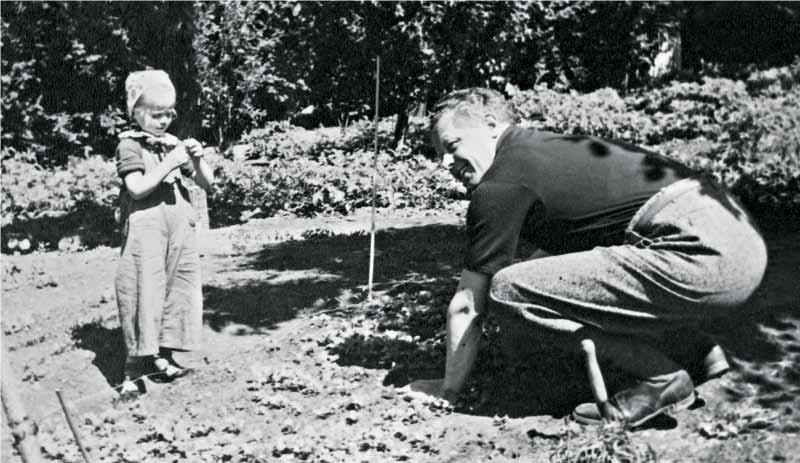
Little Ghita with her Dad in the garden
Ghita’s Own Rose
Ghita herself has in fact become a rose — quite literally.
It is called Ghita Renaissance. The rose was developed by the Danish breeders Poulsen Roser, and although she did not choose it herself, she is pleased to lend her name to its large double pink flowers and its fragrance, which has won several international prizes.
She has two of them in her own garden, though she does not give them more attention than the other roses.
“But it is a great honour to have a rose named after you. It takes a long time to develop a rose, and it is a great piece of work.”
She says she always feels deeply grateful when someone does something kind for her or shows her special attention.
“Also when people come up to me in the street — or in the supermarket — and tell me that they think I have done something well.”
It is Amusing to Grow Old
“Yes,” Ghita answers when asked whether her book is a tribute to diversity.
“It is a tribute to diversity — and to the richness of having a piece of land. For some people! Because not everyone finds joy in gardening.”
Ghita is not missionary about it. Even though she describes herself in the book as “a bulldozer who manages on her own and finds it difficult to ask others for help,” it lies deep within her that there must be room for everyone.
“Being open and accepting is probably something that comes naturally to me, but of course it also becomes easier with age. Just as it becomes easier to lose yourself in something.
“In fact, I think it is quite amusing to grow old. Now I stand on my own two feet and say what I think without worrying about whether I am pleasing others — or being afraid that I am not. I care more about walking on the grass than about what others think of me.”
Of course, she adds, every age comes with its own challenges. She regrets, for instance, that problems with her knees mean she can no longer mow the lawn herself.
“But luckily I have a lovely gardener who helps me.”
An Oasis for the Soul
Ghita’s joy in seeing things sprout and grow goes back to her childhood. Every summer her father would, as she puts it, “go into the soil” at a rented summer house.
It was together with him that the seed of her love of gardening was planted at an early age.
“You should never force children to work in the garden,” she says. “If they are going to help, it must come from their own desire — otherwise they risk losing the joy of it. Or at least you should pay them for mowing the lawn.”
“For me, working in the garden has become a breathing space for everything. You step out of your own egoism and are freed from your burdens. Your thoughts move somewhere else.
“I think losing yourself is the best thing in the world. It is the same feeling as when you play with children and build a little bakery. What would you like? Two buns, please!”
“It is about daring to surrender. To make yourself available. But it requires courage, and many people do not dare to go there — perhaps because we have become so concerned with how we appear to others.”
But Ghita dares — both in the garden and on the stage.
She says she has no artistic vanity and continues:
“I know perfectly well that the murderer is in the closet — it says so in the script. But every single time I walk onto the stage, I convince myself that everything is happening for the first time.”
Smiling at Her Ground Elder
On June 4th Ghita can be seen as the grandmother in Fanny and Alexander at the Royal Danish Theatre. But when she is not performing, she will most likely be occupied with seeing which roses have survived the hardships of winter and preparing everything for the coming summer.
She also grows tomatoes in her dressing room at the Royal Danish Theatre’s new playhouse, which she describes as “a perfectly good greenhouse.”
And although it is clear that she is not particularly fond of the building’s architecture and misses ordinary windows that can be opened and closed, one senses that — in other areas of life as well as in the garden — she has both the ability and the practice of smiling at her ground elder.


Actor, Ghita Nørby, born 1935. Grew up in Nyhavn in Copenhagen as the daughter of the Royal Danish opera singer Einar Nørby and the pianist Guldborg Laursen.
She trained at the Royal Danish Theatre’s drama school in 1956 and made her film debut the same year in Ung leg. Since then, she has appeared in nearly a hundred films as well as countless theatre productions, including the film Dance with Regitze, Denmark’s submission for the Academy Award for Best Foreign Language Film in 1990.
Over the years she has received a long list of prestigious awards and honours, including four Robert Awards, four Bodil Awards, the Commander’s Cross of the Order of Dannebrog, and Queen Margrethe II’s cultural medal Ingenio et Arti.